Saturday, 10 May 2014

Concert with Alejandro Reyes, Victor Jara's Friend.


FOREST OF DEAN CONCERT, GARDEN CAFE. FROM UK TOUR APRIL 2014

Special evening with Alejandro Reyes, doctor and great friend to the Jara family.
Now 83, Alejandro was a fellow member of CUNCUMEN, singing with Victor himself.


"Plegaria a un Labrador"

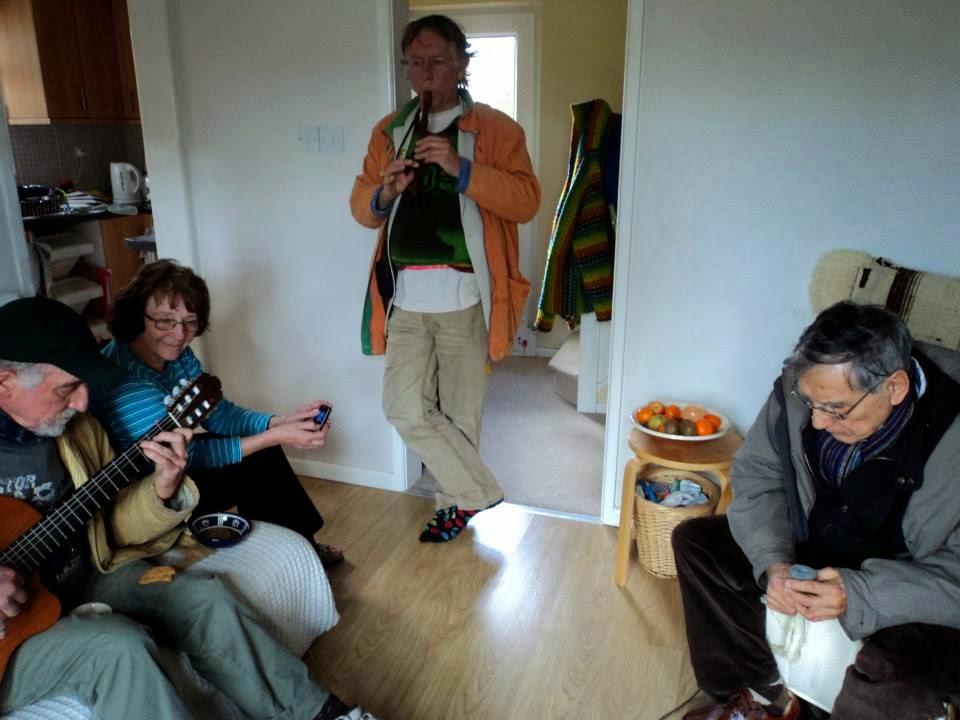
Tony, Alejandro, PBH, Cristina


Big sis Christine, Cristina, Paulina, Alejandro, PBH, son Joe(l) 


Two 'old relics' celebrate the poetry of Victor's songs. 
Joe communes with Katy Perry.


"Me escapo un sospiro"

Tony, Cristina, Alejandro


PBH, Christine, Tony, Alejandro

Pre-gig practice of "I Thought I Heard Sweet Victor, Singing", the song that came to me
in Joan and Victor's garden in Santiago.  Wonderfully, Alejandro loved it.

Here's a wonderful video of Alejandro talking about his time singing with Victor:
https://www.youtube.com/watch?v=9UJiR5AqIT0&list=PL44B296E7202DD06B

Here's Tony and me with Chilean friends, 
working out a recording of "I Thought I Heard Sweet Victor":
https://www.youtube.com/watch?v=5Tti7tGNUow

The Chilean 'choir' was composed of torture survivors/relatives of 'disappeared' people.
Recorded in the heart of the Victor Jara Foundation in Santiago, November 2013
By film-maker and friend, Malcolm Boorer. 

Just how lucky can one old relic get?

Friday, 9 May 2014

Dream on, Mr Osborne! "I don't want us to be the only people out there in front of the rest of the world." (George Osborne).

Why we couldn't care less about the natural world

Locals cross flooded railway lines after the river Thames burst its banks in Datchet.The richer we are and the more we consume, the more self-centred and careless of the lives of others we appear to become731

Locals cross flooded railway lines after the river Thames burst its banks in Datchet. Photograph: Peter Macdiarmid/Getty Images
That didn't take long. The public interest in the state of the natural world stimulated by the winter floods receded almost as quickly as the waters did.
A YouGov poll showed that the number of respondents placing the environment among their top three issues of concern rose from 6% in mid-January to 23% in mid-February. By early April – though the Intergovernmental Panel on Climate Change had just published two massive and horrifying reports – the proportion had fallen back to 11%.
CarbonBrief has plotted the results on this graph:


Public response to UK floods
Public response to UK floods. Photograph: /CarbonBrief

Sustaining interest in this great but slow-burning crisis is a challenge no one seems to have mastered. Only when the crisis causes or exacerbates an acute disaster – such as the floods – is there a flicker of anxiety, but that quickly dies away.
Why is it so difficult to persuade people to care about our wonderful planet, the world that gave rise to us and upon which we wholly depend?
And why do you encounter a barrage of hostility and denial whenever you attempt it (and not only from the professional liars who are paid by coal and oil and timber companies to sow confusion and channel hatred)?
The first thing to note, in trying to answer this question, is that the rich anglophone countries are anomalous. In this bar chart (from the New York Times) you can see how atypical the attitudes of people in the US and the UK are. Because almost everything we read in this country is published in rich, English-speaking nations, we might get the false impression that the world doesn't care very much.


Bar chart from NYT
Attitudes to climate change. Photograph: NYT/Pew

This belief is likely to be reinforced by the cherished notion that we lead the world in knowledge, sophistication and compassion. The bar chart puts me in mind of the famous quote perhaps mistakenly attributed to Gandhi. When asked by a journalist during a visit to Britain, "What do you think of western civilization?", he's reputed to have replied, "I think it would be a good idea."
Our erroneous belief that we are more concerned about manmade climate change than the people of other nations informs the sentiment, often voiced by the press and politicians, that there's no point in acting if the rest of the world won't play its part. For example, last year the chancellor, George Osborne, remarked:
I don't want us to be the only people out there in front of the rest of the world. I certainly think we shouldn't be further ahead of our partners in Europe.
But we're not "the only people out there in front of the rest of the world." In fact we're not in front at all. As this map produced by Oxford University's Smith School suggests, we are some way behind not only some other rich nations but also a number of countries much poorer than ours.


Oxford University's Smith School climate change map
Oxford University's Smith School climate change map. Photograph: Oxford University's Smith School

As for the US, Australia and Canada, they are ranked among the worst of all: comprehensively failing to limit their massive contribution to a global problem. We justify our foot-dragging with a mistaken premise. Our refusal to stop pumping so much carbon dioxide into the atmosphere is pure selfishness.
Both the map and the bar chart overlap to some degree with the fascinating results of the Greendex survey of consumer attitudes.
For years we've been told that people cannot afford to care about the natural world until they become rich; that only economic growth can save the biosphere, that civilisation marches towards enlightenment about our impacts on the living planet. The results suggest the opposite.
As you can see from the following graph, the people consulted in poorer countries feel, on average, much guiltier about their impacts on the natural world than people in rich countries, even though those impacts tend to be smaller. Of the nations surveyed, the people of Germany, the US, Australia and Britain feel the least consumer guilt; the people of India, China, Mexico and Brazil the most.


Greendex survey of consumer attitudes
Greendex survey of consumer attitudes. Photograph: /Greendex

The more we consume, the less we feel. And maybe that doesn't just apply to guilt.
Perhaps that's the point of our otherwise-pointless hyperconsumption: it smothers feeling. It might also be the effect of the constant bombardment of advertising and marketing. They seek to replace our attachments to people and place with attachments to objects: attachments which the next round of advertising then breaks in the hope of attaching us to a different set of objects.
The richer we are and the more we consume, the more self-centred and careless of the lives of others we appear to become. Even if you somehow put aside the direct, physical impacts of rising consumption, it's hard to understand how anyone could imagine that economic growth is a formula for protecting the planet.
So what we seem to see here is the turning of a vicious circle. The more harm we do, the less concerned about it we become. And the more hyperconsumerism destroys relationships, communities and the physical fabric of the Earth, the more we try to fill the void in our lives by buying more stuff.
All this is accompanied in the rich anglophone nations with the extreme neoliberalism promoted by both press and politicians, and a great concentration of power in the hands of the financial and fossil fuel sectors, which lobby hard, in the public sphere and in private, to prevent change.
So the perennially low level of concern, which flickers upwards momentarily when disaster strikes, then slumps back into the customary stupor, is an almost inevitable result of a society that has become restructured around shopping, fashion, celebrity and an obsession with money.
How we break the circle and wake people out of this dreamworld is the question that all those who love the living planet should address. There will be no easy answers.

Wednesday, 7 May 2014

Comment on "Western intervention will turn Nigeria into an African Afghanistan"

I live and work in Nicaragua with abused children. They also have been subjected to appalling abuse due, in large measure, to the effects of western destruction and greed. The very fabric of a Two -Thirds World society such as ours has been shredded by centuries of callous military intervention and eco/economic/gender exploitation by the Me-First World. Given its magnificent and abundant natural resources and hard-working people, especially its women, Nicaragua should be a paradise. Instead it's rated the second poorest country in the Western hemisphere. For 'poorest' read 'impoverished' - made, continually and actually being made, poor. This to help support the ultimately unsustainable lifestyle of the US, Europe and the economic 'elites' of so many other countries. 

Including that of us woolly liberals and guardianistas. As a direct result of this ongoing greed, adolescent girls and boys are effectively enslaved here on a daily basis. Several of our family members work in factories producing brand name jeans and sneakers that we me-firsters simply 'have' to have. The price we pay for a single pair of 'designer' jeans is more than they get paid in a month. A month of 12 hour days, with 20 minutes for lunch, and rigidly-controlled bathroom breaks, thanks to which many of 'the girls' have serious urinary problems.


As everywhere, there are of course many local problems and much local greed - Nicaraguans are human too! But the author of this article is exactly right to underline our complicity in the fate of the Nigerian students. It is, in large (not only) measure, part and parcel of the Me-First West's supremely immoral behaviour towards the Two-Thirds World over centuries of direct colonialisation/military intervention and ongoing gender/eco/economic exploitation. The denial and finger-pointing she evokes are no more than the standard knee-jerk response of so many of us - myself often included - who know we have to change, and change dramatically since we now see the writing even on the planetary wall, but who are too frightened/comfy/greedy to do the right thing. Coraje compaƱer@s. For all its foibles and faults, and despite all we've done and tried to do to little Nicaragua, it is in fact at least a mini-paradise, a place of great happiness, community and creativity. We should/could all be so lucky!

Western intervention will turn Nigeria into an African Afghanistan

Western intervention will turn Nigeria into an African Afghanistan

The plight of kidnapped girls is set against the corruption and inequality that the west's economic war has helped to create
Protest against Shell after a oil spill from a Shell oil field in Nigeria
A protest against Shell after a oil spill in 2011. 'There is widespread corruption, yet weapons and armies are paid to protect the wealthy and the foreign companies like Shell that want to access the country’s resources, especially oil.' Photograph: George Esiri/EPA
It seems almost beyond belief that more than 200 girls can be kidnapped from a school in northern Nigeria, held by the terrorist group Boko Haram, and threatened on a video – shown worldwide – with being sold into slavery by their captors. The disbelief is compounded by today's news that, overnight, eight more girls have been kidnapped by suspected Boko Haram gunmen in north-east Nigeria. This tragedy touches the hearts of everyone, evoking a feeling of revulsion not only at the danger and loss of freedom itself, but at the assumption that for young girls their destination must be forced marriage and servitude, not education.
There is rightly anger that so little has been done by the Nigerian government to find the girls, and that those who have demonstrated in huge numbers against President Goodluck Jonathan have themselves been accused of causing trouble or even temporarily arrested.
But we should be wary of the narrative now emerging. This follows a wearily familiar pattern, one we have already seen in south Asia and the Middle East, but that is increasingly being applied to Africa as well.
It is the refrain that something must be done and that "we" – the enlightened west – must be the people to do it. As the US senator Amy Klobuchar put it: "This is one of those times when our action or inaction will be felt not just by those schoolgirls being held captive and their families waiting in agony, but by victims and perpetrators of trafficking around the world. Now is the time to act."
The call has been for western intervention to help find the girls, and to help "stabilise" Nigeria in the aftermath of their kidnap. The British government has offered "practical help".
Yet western intervention has time and again failed to deal with particular problems and – worse – has led to more deaths, displacements and atrocities than were originally faced. All too often it has been justified with reference to women's rights, claiming that enlightened military forces can create an atmosphere where women are free from violence and abuse. The evidence is that the opposite is the case.
Women's rights were a major justification for the Afghanistan war, launched in 2001, when Cherie Blair and Laura Bush supported their husbands' war as a means of liberating Afghan women. Today, with millions displaced and tens of thousands dead, Afghanistan remains one of the worst countries on earth for women to live, with forced marriage, child marriage, rape and other atrocities still occurring widely.
And western intervention is already firmly embedded in Africa. It does not have the same profile as in Afghanistan or Iraq, because past wars have made it harder to put boots on the ground. But Barack Obama has his military forces engaged in West Africa through their Predator drone base in Niger, which borders northern Nigeria. It also borders Mali, the scene of recent French and British interventions, and Libya, object of a disastrous western bombing campaign in 2011 that has left that country in a state of civil war and collapse.
US drones also operate in Djibouti, Ethiopia and just across the Red Sea in Yemen. The west has been engaged in proxy wars in Somalia in recent years.
If Islamism is now a threat to western interests in growing parts of Africa, it is one that they have played a large part in creating.
But there is another war going on in Africa: economic war. A continent so rich in natural resources sees many of its citizens live in terrible conditions. In President Jonathan's Nigeria, economic growth has not trickled down to the poor. Healthcare and education are beyond the reach of many.
There is widespread corruption, yet weapons and armies are paid to protect the wealthy and the foreign companies, such as Shell, that want to access the country's resources, especially oil. This corruption and inequality is not separate from the role of the west, but an integral part of a system that is prepared to go to war over resources such as oil and gas, but will not go to war on poverty or to provide education for all.
It is this background that informs the terrible plight of the kidnapped girls in Nigeria. It will not be improved by more western weapons and armies on the ground or in the air.

Tuesday, 6 May 2014

Is Your Coffee Destroying the Environment?

Is Your Coffee Destroying the Environment?

Is Your Coffee Destroying the Environment?
I hate to be the bearer of bad news, since like thousands of others, I love nothing more than my latte fix. But according to a study published in the latest issue of BioScience and written about in the Huffington Post “the world’s coffee farms are now more harmful to the environment than ever.”
The study’s authors, led by Shalene Jha of the University of Texas, discovered that right now, a far larger share of the world’s coffee is now being grown in direct sunlight, rather than under the shade of a canopy of trees. You’ve probably heard of the importance of shade grown coffee, but what happens when coffee’s not grown in these ideal conditions? Well, “these full-sun coffee farms are scarcely any different from the large plots of monoculture corn and soybeans that have been vilified by environmentalists over the past several decades,” says Joe Satran of the Huffington Post.
The large trees some coffee is grown under is important to the environment, as it provides a natural habitat for native wildlife, supports soil health and fights erosion, along with other benefits to fruit and firewood. “Our scientists say a certified coffee farm is the next best thing to rainforest,” Chris Wille, the head of sustainable agriculture at Rainforest Alliance, said of shaded farms.
“The expansion of coffee that we’ve seen in the last two decades has largely been in places where coffee is grown in this low-shade, very intensive style, where there are no overstory trees,” Jha said. “And in this manner of production, the coffee really doesn’t last very long, and it really degrades the environment.”
So if it’s better, why have we grown so far away from shaded coffee? Simply put, it’s due to the growth of the coffee industries in Brazil and Vietnam, the first- and second-biggest producers in the world in 2010, according to the study. The researchers found that more than three-quarters of the coffee farmland in those two countries contains no tree cover.
Unfortunately, much of the cheap coffee from chains likely comes from full-sun farms. As the study points out, “The industries in these two countries are dominated by the cultivation of inexpensive, bitter-tasting robusta coffee, which is used to make instant coffee and the bulk ground coffee you might buy in a can at a supermarket.”
Super popular options, like Starbucks and Dunkin’ Donuts, typically use beans from arabica coffee plants, a different species from robusta, to make their brews. But while arabica is more likely to be grown in the shade, Jha noted that “much of the world’s arabica is still grown in direct sun, or on partially shaded farms that offer environmental benefits far more modest than fully-shaded farms.”
The study’s authors estimated that “the share of the world’s coffee farms that employ traditional shade-growing methods plummeted from 43 percent to 24 percent between 1996 and 2010 — just as savvy consumers were waking up to the joys of higher-quality coffee. A whopping 41 percent of the coffee farmland contained no shade trees at all in 2010, an all-time high.”
Originally, because coffee plants evolved in the understory of the East African jungle, they were grown only in shade for the first several hundred years of human cultivation. But in the 1970s, the shift to direct sunlight was used in hopes of increasing photosynthesis, preventing disease and to allow greater density of shrub planting. Farmers began cutting down the tree canopies that shaded their shrubs and compensated for the loss of natural insect-killing birds and bats by applying more pesticides.
This strategy helped farms produce much more coffee, especially in Brazil, where coffee is grown in sunned, mechanically tended crop circles. Some (including Jha) argue that “beans grown in direct sunlight taste worse than coffee grown in the shade,” but Dan Cox, president and owner of Coffee Analyst, a coffee testing company in Burlington, Vermont, doesn’t agree. “There is a slight, if at all, perceivable taste difference between shade coffee and non-shade coffee,” he said. “I don’t think the issue with full sun is taste, ultimately — I think it’s biodioversity.”
That’s where Jha and her co-authors come in. They argue that “getting rid of the trees eliminates a crucial habitat for native wildlife, such as tropical birds and monkeys, and makes the land more susceptible to erosion and climate change. And using more chemicals creates still other problems.”
Robert Rice, a research scientist at the Smithsonian Migratory Birds Center and a co-author on the paper, also chimed in. “We know now from decades of high-input industrial agriculture in the U.S. that by shifting away from traditional practices, you lose an incredible amount of topsoil, you contaminate waterways and you make yourself much more vulnerable to changes in weather.”
According to Jha, the only way to ensure that your coffee is good for the planet is to buy beans that have been certified by Rainforest Alliance, or, even better, the Smithsonian Migratory Bird CenterOrganic and fair-trade beans are great too, she said, but “those certifications do not specifically account for shade cover or biodiversity.”
What do you think, Care2? Do you take care when buying your coffee?
Source: Huffington Post
Related:


Read more: http://www.care2.com/greenliving/is-your-coffee-destroying-the-environment.html#ixzz30vwRGOEH

Sunday, 4 May 2014

How big-hearted babies turn into selfish monsters

How big-hearted babies turn into selfish monsters

Our natural instinct for altruism is being destroyed by the demands of modern life, says a new book
A baby being fed with a spoon
A baby being fed a homemade meal, starting with cereals, vegetables and fruits, will need half as much as being weaned on ready-made food. Photograph: Jamie Grill/Getty
If you've been planning a shopping trip with the kids for bank holiday Monday, you might not want to read any further, because teaching yourchildren consumerism is helping to turn them into selfish, immoral creatures without a streak of empathy, according to a new study. You may be making them just like stressed-out adults, whose potential as human beings is killed off as genuine altruism is suffocated by their greed and anxiety.
In a new book which suggests that social changes and the shift towards an ever more unequal society are making us cold-hearted and mean, psychotherapist Graham Music says we're more likely to be born big-hearted and kind but then pushed towards being selfish and cold than the other way around.
"We're losing empathy and compassion in dealing with other people in our society," said Music, a consultant child and adolescent psychotherapist at the Tavistock and Portman clinics in London. "There is a lot of evidence that the speed of life and the resultant anxiety have an enormous impact on how we deal with other people. We all know it anecdotally. You live in a dog-eat-dog world and it makes sense to be highly stressed and vigilant to cope with it. From that stress come some really fundamental shifts in behaviour, along with pretty poor outcomes in everything from health to life expectancy and happiness."
A study last year by Michegan University showed that adolescents exposed to the cruelties of reality television – where nasty spats along with vicious judgements of others is the entertainment – made them even more socially agressive. Music says the casual meanness on shows like X Factor and Britain's Got Talent is an example of how cold-hearted we are becoming.
His new book, to be published at the end of the month, is called The Good Life: Wellbeing and the New Science of Altruism, Selfishness and Immorality. The latest in a series of publications to suggest a current imbalance in the UK, it collates decades of social experimental research and draws on Music's experience as a consultant to paint a grim picture of a western society undermining its natural tendency towards empathy and tipping dramatically towards nastiness.
Music disputes the notion that children are born selfish. He points to a series of experiments at the Max Planck Institute in Germany, when a group of 15-month-olds were placed in a room where an adult pretended to need help. "There is a proven urge to help. The toddlers love helping, they get an intrinsic reward just from the act, until they start to reward them for that behaviour with a toy. The group of toddlers rewarded 'extrinsically' – that is, with a toy – quickly lost interest in helping. The unrewarded children – who don't know the other group are getting rewards – keep on helping, content with no ulterior reason other than the act of helping."
Other studies have shown that toddlers feel happier giving treats than receiving them, says Music. "Then we have evidence that adolescents asked to do a good deed once a day become less depressed. We've evolved to be helpful and to do things without reward. Rewards don't make anyone happy and something very fundamental is lost when we reward for certain behaviours. We all know it, but we've lost sight of it as we're suckered into the consumer ethos, the deep insistence that we need that iPhone or that new kitchen to be happy – and we fall for it again and again. Those very powerful drivers of post-industrial capitalism and mass media are brilliant at triggering those needs and, after all, you can't sell wellbeing."
Music points to stress as keeping us in a state of "fight or flight". "It doesn't make any sense to be interested in others or what they are thinking or feeling if your nervous sytem is in flux," he said.
The book details several social experiments, including one from 1973, when theology students were told they had to give a talk about the parable of the Good Samaritan. Half were told to do it immediately the rest were given time to prepare. As they left the room, they passed an actor who was in some trouble. Those who had to prepare quickly ignored him, while the others stopped to help.
"The speed of life has an impact on our altruism," said Music. "This is going on in schools as well. Stress is seeping into our schools with this heavily academically-based curriculum, an audit culture. I'm really worried about that from the children I see in my clinics."
Music says there is a desperate need to rethink our materialistic tendencies. "A very monetised western world is going to make us more and more lose touch with our social obligations," he said.
Maybe it's not too late to rethink that shopping trip.

Saturday, 3 May 2014

'Engage' with the Middle East? Surely Blair means 'bomb'?

Engage with the Middle East? Surely Blair means 'bomb'?

Tony Blair's recent speech was packed with darkly flexible terminology. Perhaps he is owed an 'intervention' of his own
Tony Blair Speech
Tony Blair delivering his speech at Bloomberg last week. Photograph: Peter Macdiarmid/Getty Images
Have you ever experienced a painful engagement? There you are, betrothed to your beloved, but something goes wrong and it is broken off in tears and recriminations. Tony Blair knows how you feel, and wants you to know he knows. In his speech last week, the Middle East envoy for the Quartet (the UN, the US, the EU and Russia) described the wars in Afghanistan and Iraq that he helped to start as "painful engagements".
No doubt they were painful for the victims, but the pain of those maimed and killed was not Blair's focus. These "engagements" were "painful", he meant, for the perpetrators, who were sensitive enough to feel bad while raining death down on thousands from halfway around the world. It is a matter of regret that these "engagements" in Iraq and Afghanistan have been "painful", said Blair, because now "public opinion in the UK and elsewhere resents the notion that we should engage with the politics of the Middle East and beyond".
By "engage with the politics of the Middle East", Blair of course meant "bomb people we don't like in the Middle East". But he or his speechwriters have lost none of their awe-inspiring capacity for bellicose euphemism. In this speech recommending more "engagements", whether painful or ecstatic for those loosing the hi-tech weapons, we also witnessed that old standby "no-fly zone", which actually means "flying-and-bombing zone", and the hoary old self-satisfied reference to our having "change[d] the regimes" in Afghanistan and Iraq, as though Blair and his chums had merely been shuffling around tiny figurines on the Game of Thrones opening credits map.
Blair is clearly still worried about what people think of those wars, to the extent that he essayed the splendid gambit of suggesting that it is still too soon to judge that they weren't, after all, perfectly brilliant ideas. "It may well be," Blair proposed wistfully, "that in time people come to view the impact of those engagements differently." He didn't say how much time such a change of heart would take. But we must all agree that in principle it's perfectly possible that in a million years the evil cyborgs who have replaced humanity will look fondly on the capacity for organised killing of mere flesh-and-blood organisms in the early 21st century.
Perhaps the most darkly flexible term of Unspeak here, though, was the apparently innocent word "intervention". Blair was urging the world to "intervene" more in the Middle East, just as he and Bush had "intervened" in Iraq. But what, exactly, did they "intervene" in back then? There was no civil war in Iraq in early 2003. The Latin derivation of "intervention", "coming between", seems quite plainly to require the existence of two parties at loggerheads, between whom the intervener positions himself as peacemaker. But the war in Iraq was just an invasion. In a forlorn example of what we may call the media's rhetorical Stockholm syndrome, several newspapers reporting on Blair's speech also referred in their own words to Blair's "intervention" in Iraq, thus helping him to justify it retrospectively.
Deployment of the term "intervention" shunts moral responsibility on to an imaginary third party. But the word still does a lot of persuasive work even when a conflict already exists. To propose that we "intervene" in the war in Syria, for example, once again shunts aside the reality of dropping bombs and inevitably killing lots of noncombatants. It assumes a position of flawless moral wisdom and figures the concerned bomb-dropping western powers as wise teachers breaking up a gang of squabbling children on the playground.
It exploits, too, the connotations of "intervention" as something that is good for you even if you don't want it – as in an intervention made by the friends and family of someone who is drinking too much, or a medical intervention that will hurt but save your life. Refusing such an intervention at the hands of a wise surgeon would be worse than suffering it. In this way, Blair found himself able to say, after sketching a Manichean picture of the world as divided between enlightened liberal democracy and Islamist theocracy: "This is what makes intervention so fraught but non intervention equally so."
And so the moral equivalence was blithely asserted between, on the one hand, bombing lots of people, and on the other hand, not bombing lots of people if it doesn't seem very likely to make things much better for everyone (except the people you have just bombed). Perhaps Blair is now a prime candidate for some tough-love intervention himself.